

Capital gains tax on property sold at auction: what you need to know
If you’re planning to sell a property at auction, capital gains tax on property sold at auction is one bill you cannot afford to overlook. The hammer falling doesn’t just mark the end of a sale, it starts a strict countdown with HMRC. Understanding your position early means you can plan your finances properly, rather than scrambling once the deadline is looming.
Selling at auction is fast, but that speed cuts both ways. While a private sale can drag on for months, an auction contract is binding the second the gavel comes down. That certainty is one of the reasons sellers choose the auction route selling a property at auction but it also means your tax clock starts sooner than you might expect, well before the paperwork or the sale proceeds actually reach you.
What is capital gains tax on property sold at auction?
Capital gains tax (CGT) is charged on the profit you make when you sell an asset that has grown in value, not on the total sale price. If you bought a buy-to-let flat for £150,000 and sold it for £220,000, your gain is £70,000, and it’s that figure HMRC is interested in, not the £220,000 itself.
Capital gains tax on property sold at auction applies to most residential and commercial disposals that aren’t your main home. Buy-to-let investments, inherited houses, land, and business premises are all common examples. Your own home is usually protected by Private Residence Relief, provided it has been your only or main residence throughout your ownership, and provided you haven’t let out a significant part of it to tenants.
When does your tax bill kick in — the moment the hammer falls
Why the auction date matters more than completion day
With a private treaty sale, the date that matters for tax is usually the date contracts are exchanged. At auction, exchange and the fall of the hammer happen at the same moment, so that’s your disposal date for capital gains tax purposes, even though completion typically follows 20 to 28 days later.
This distinction catches sellers out. You might not receive your money until completion, but HMRC starts counting from the auction date itself. Getting your figures ready before the sale, rather than after, is the safest way to stay ahead of your reporting obligations understanding auction day to completion Waiting until the funds land in your account is a common mistake, and one that leaves far less time to gather the paperwork HMRC will expect.
Working out your taxable gain
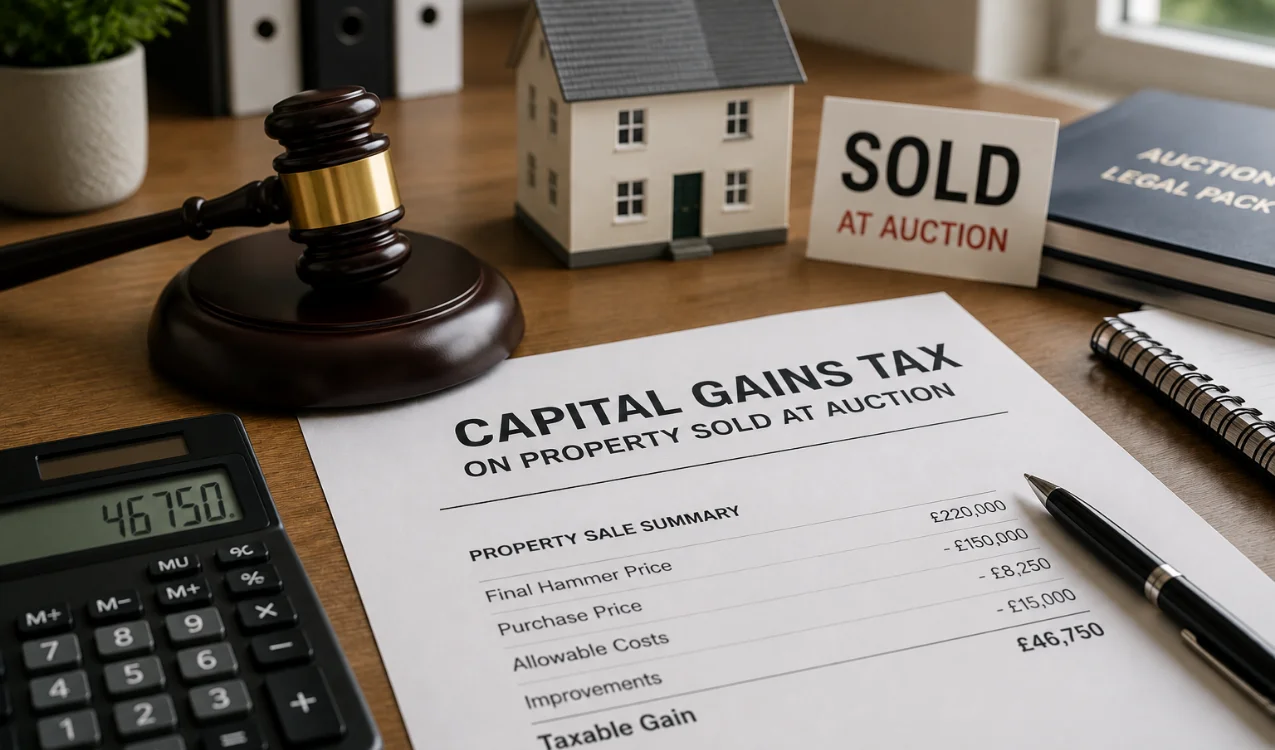
Calculating what you actually owe starts with the hammer price, then works backwards through your allowable costs. The formula looks like this:
- Final hammer price achieved at auction
- Minus your original purchase price
- Minus buying and selling costs (solicitor fees, auctioneer’s commission, legal pack preparation)
- Minus qualifying capital improvements (an extension, a new roof, a loft conversion)
- Equals your taxable gain
Routine maintenance, such as redecorating or fixing a leak, doesn’t count as a capital improvement and can’t be deducted. Keeping receipts for every auction-related cost, from legal pack drafting preparing your legal pack for sale to marketing fees, will make this calculation far easier when the time comes, and will stand you in good stead if HMRC ever queries your figures.
The current capital gains tax allowance and rates
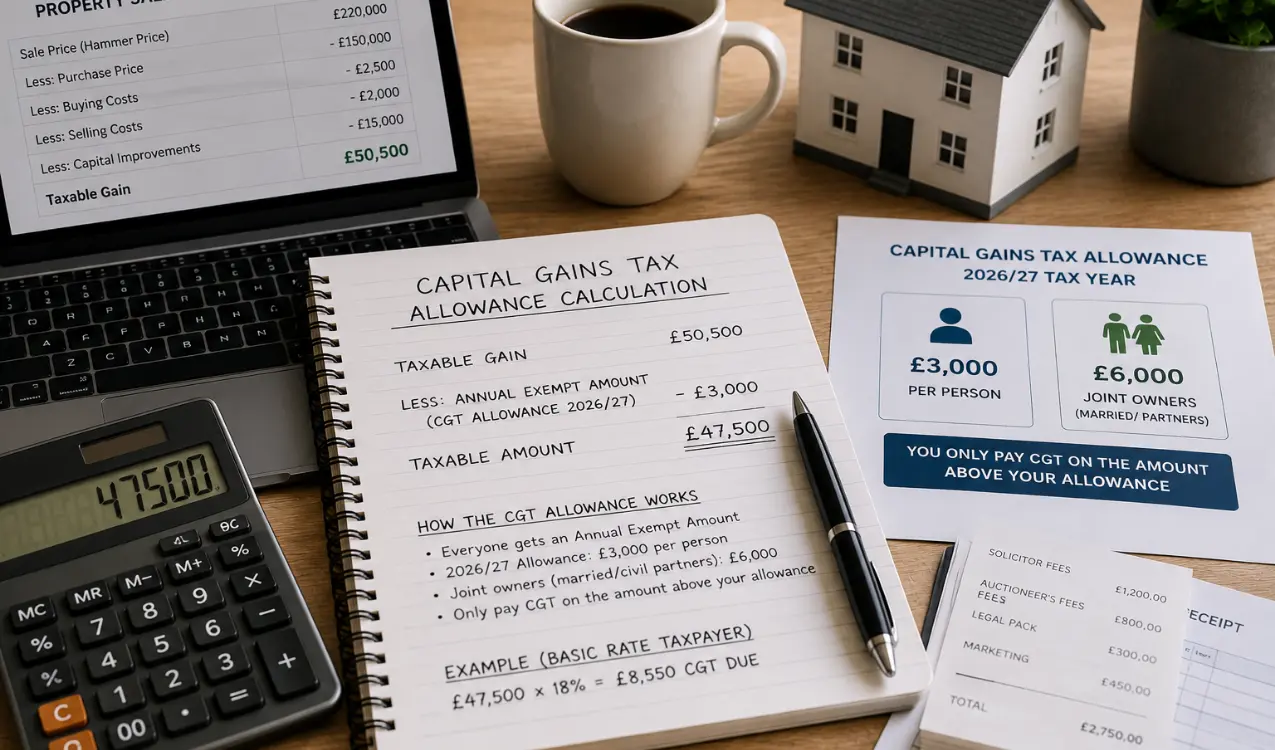
Every individual has a capital gains tax allowance, known as the Annual Exempt Amount, which lets you earn a certain amount of gain each tax year completely free of tax. For the 2026/27 tax year, that capital gains tax allowance is £3,000 per person, or £6,000 if you own the property jointly with a spouse or partner and can combine your allowances.
Once your gain is above the capital gains tax allowance, the rate you pay depends on your income. Basic rate taxpayers currently pay 18% on residential property gains, while higher and additional rate taxpayers pay 24%. Commercial and land sales are taxed differently again, so it’s worth checking your own position, or getting professional advice, before you rely on estimated figures.
You can report and pay your Capital Gains Tax through HMRC’s online service once you have your final figures, though most sellers find it easier to have a solicitor or accountant check the numbers first.
The 60-day reporting deadline explained
Once your sale completes, you’re required to report and pay any tax due within a 60-day reporting deadline. This applies to most UK residential property disposals where tax is owed, and the 60-day reporting deadline is measured from the completion date, not the auction date itself.
What happens if you miss the 60-day reporting deadline
Missing the 60-day reporting deadline triggers an automatic £100 penalty from HMRC, with further penalties and interest building up the longer the return goes unfiled. Because auction sales complete quickly, often within a month of the hammer falling, sellers can find the 60-day reporting deadline arrives faster than they expected. Preparing your figures during the marketing period, rather than waiting for completion day, gives you a much safer margin, and means you’re never scrambling for paperwork at the last minute.
Not sure how much tax you'll owe on your sale?
Every sale is different, and your figures depend on your purchase price, your costs, and your own income tax position. speak to our team before you go to auction, and we can help you understand what to expect once the hammer falls.
Special situations: inherited, jointly owned and commercial property sold at auction
Inherited property benefits from a “step-up” in value. Your acquisition cost is reset to the property’s market value on the date of death, rather than whatever the original owner paid. Because an auction produces a transparent, competitive sale price, executors often find this is the clearest possible evidence of value for both capital gains tax and probate purposes, which can make settling an estate considerably more straightforward.
Jointly owned property lets both owners use their own capital gains tax allowance against their share of the gain, effectively doubling the tax-free amount available to a couple. Commercial and mixed-use property, such as a shop with a flat above it, is taxed at different rates again, and the gain usually needs to be split between the residential and commercial portions before you can work out what’s owed on each.
Keeping a simple spreadsheet of your original purchase costs, ongoing improvements and eventual sale costs as you go, rather than trying to reconstruct everything after completion, is one of the easiest ways to avoid an unpleasant surprise when the final figures are added up.
How to keep your capital gains tax bill down
A little preparation before your sale can make a real difference to what you eventually owe:
- Keep every receipt for buying and selling costs, including solicitor and auctioneer’s fees
- Record capital improvements separately from routine repairs and maintenance
- Use both partners’ capital gains tax allowance if the property is jointly owned
- Get your figures ready during the marketing period, not after the hammer falls
- Speak to an accountant or tax adviser if your gain is substantial or the ownership structure is complex
Auction sellers who prepare early tend to find the whole process, including capital gains tax on property sold at auction, considerably less stressful than those who leave it until the reporting deadline is looming over them.
Ready to sell your property at auction with confidence?
Selling at auction gives you a fixed date, a competitive price and a clear paper trail, but it also means your capital gains tax obligations move quickly. Getting the right legal and financial support in place before you go to auction means there are no surprises once the hammer falls, and no last-minute scramble to meet HMRC’s deadline.
