


What is a Decision in Principle (DIP) and do you need one before bidding at auction?
A Decision in Principle — also known as a Mortgage in Principle or Agreement in Principle — is a conditional statement from a mortgage lender that they would, in principle, be willing to lend you a specified amount based on an initial review of your finances. It is a useful tool when buying through an estate agent, but its relevance at a property auction is more limited than many first-time auction buyers realise.
The short answer to whether you need a decision in principle for a property auction is: it depends entirely on the type of auction you are bidding at. For a traditional unconditional auction, a DIP is not sufficient — and relying on it without understanding this distinction can leave you legally bound to complete a purchase you cannot finance. For the modern method of auction, a DIP plays a more useful role, though it still carries important caveats.
This guide explains what a mortgage in principle before bidding actually means, what it does not guarantee, and how finance requirements differ between auction formats.
What is a Decision in Principle?
A Decision in Principle (DIP) is a document from a mortgage lender stating that, based on an initial review of your income, outgoings, credit commitments, and financial circumstances, they would be likely to lend you a certain amount. It is obtained before you make a full mortgage application and involves only a soft credit check — meaning it does not leave a mark on your credit file.
Lenders use different names for the same document. Nationwide calls it a Decision in Principle. Skipton Building Society, Halifax, and many others use Agreement in Principle (AIP). Others refer to it as a Mortgage in Principle (MIP) or a Mortgage Promise. In all cases, the legal effect is the same: it is an indication, not a commitment.
A DIP is not a mortgage offer. It does not guarantee that your full mortgage application will be approved. The lender still needs to carry out a full affordability assessment, a hard credit check, and a valuation of the specific property you intend to purchase before they can issue a formal mortgage offer. All of these steps happen after the DIP is issued — and in the case of unconditional auctions, after exchange of contracts has already occurred.
What a DIP does and does not tell you
Understanding the boundaries of a DIP is essential before approaching any property auction. It is a well-defined but limited document. Here is what it actually confirms and what remains uncertain at the DIP stage:
What a DIP confirms
- A lender has reviewed your stated income, outgoings, and credit commitments
- Based on that initial review, they would in principle consider lending up to a stated amount
- A soft credit check has been carried out and has not flagged any immediate concerns
- You have a realistic borrowing capacity that supports bidding within a particular price range
What a DIP does not confirm
- That your full mortgage application will be approved
- That the lender will accept the specific property you are bidding on — auction lots frequently have title issues, structural defects, or lease characteristics that affect mortgage eligibility
- That the property will value at the price you pay — if it undervalues, the lender’s offer may be lower than expected
- That interest rates, products, or lending criteria will not change between the DIP and your full application
- That you will be able to complete within the timescale an unconditional auction contract requires
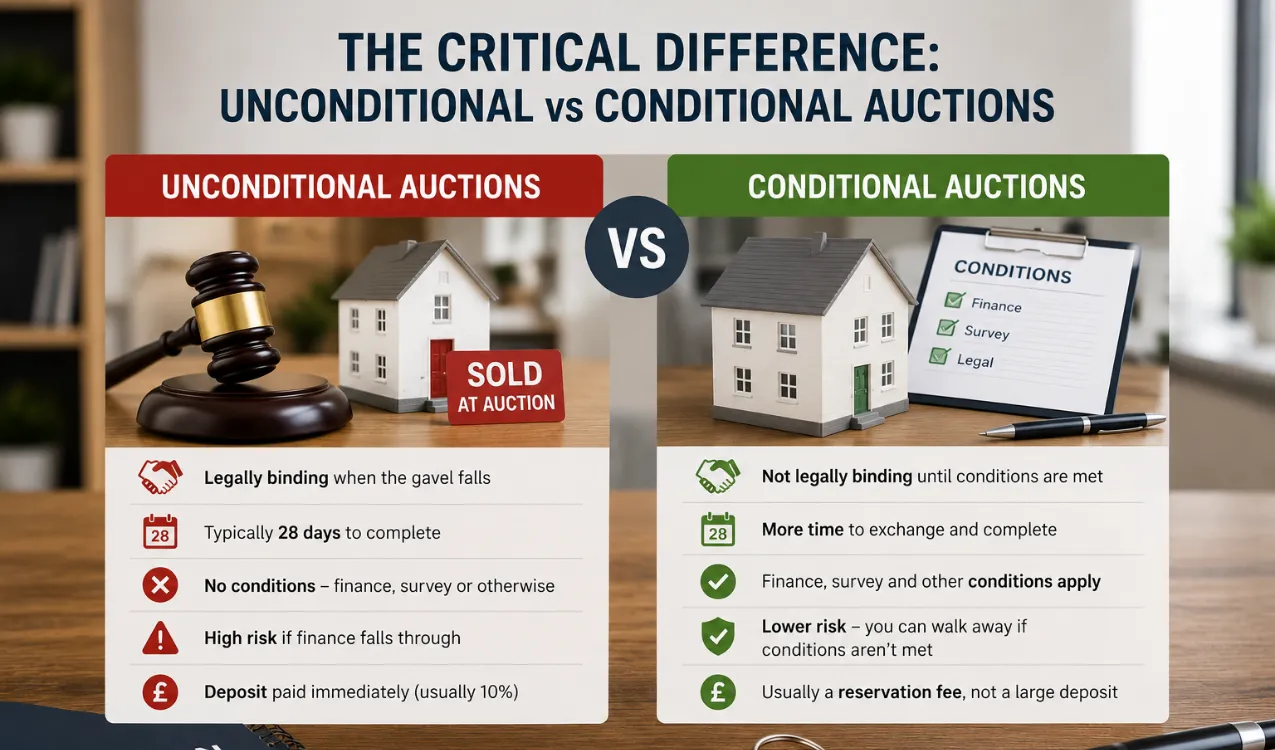
The critical difference: unconditional vs conditional auctions
The relevance of a decision in principle at a property auction depends entirely on which type of auction you are attending. There are two fundamentally different formats, and they have very different implications for finance.
Unconditional auctions (traditional auctions)
At a traditional unconditional auction, the fall of the hammer creates an immediately binding contract. You are legally exchanged at that moment. You typically have 28 days to complete. There is no cooling-off period, no option to make completion conditional on mortgage approval, and no way to withdraw without losing your deposit and potentially facing further liability.
This means that a DIP unconditional auction combination is genuinely dangerous if you have not also arranged finance that can be confirmed and drawn down within 28 days. A DIP does not secure funds. It does not mean your lender will approve the specific property. If your mortgage application is subsequently declined — because the property does not meet the lender’s criteria, because the valuation comes in low, or because a title issue is discovered — you remain contractually bound to complete regardless.
For unconditional auctions, you should either be a cash buyer, or have a formal mortgage offer already in place on the property before auction day. This is exceptionally rare in practice, as a formal offer requires a lender valuation on the specific lot — which in turn requires the lot to have been identified and a full application submitted. The alternative — and by far the most common route for mortgage buyers at traditional auctions — is to fund the purchase with a bridging loan and then refinance onto a standard mortgage after completion. Our guide to getting a mortgage for an auction property covers this in detail.
Conditional auctions (modern method of auction)
The modern method of auction (conditional auction) works differently. When your bid is accepted, you pay a reservation fee and enter a reservation period — typically 28 days — during which you carry out legal due diligence and finalise your mortgage. You then exchange contracts and have a further period to complete, usually bringing the total to around 56 days from acceptance.
In this format, a mortgage in principle before bidding is genuinely useful. It gives you confidence that you can access the level of borrowing needed, and it gives the seller confidence that your offer is financially credible. However, a DIP is still not a mortgage offer, and there remain risks: the property may not satisfy your lender’s criteria, or the valuation may come in below the price you paid. In a conditional auction, if financing falls through within the reservation period you may lose your reservation fee but are generally not liable for the full purchase price — which is a fundamentally different position from an unconditional auction.
Our guide to conditional vs unconditional auctions explains the full differences between the two formats and their respective obligations.
Bidding at auction and not sure your finance is in order?
The legal pack for the lot will often tell you more about finance eligibility than your lender can before they see the property. Many auction properties have title issues, lease characteristics, or structural notes that affect mortgage lending. Get your auction legal pack reviewed by a specialist before you register to bid.
How long does a Decision in Principle last?
A Decision in Principle is typically valid for between 30 and 90 days, depending on the lender. Nationwide issues DIPs valid for 90 days. Skipton’s DIP allows 30 days from completion to submit a full mortgage application. Most other major lenders fall somewhere in this range.
For auction buyers, the validity period matters less than it might appear. The issue is not whether the DIP expires before auction day — it is that even a current, valid DIP does not mean you can obtain a formal mortgage offer and complete a purchase within 28 days on an unconditional lot. The mortgage application process — including full affordability assessment, hard credit search, lender valuation, and underwriting — typically takes several weeks. In most cases, this means a DIP is simply not the right instrument to rely on at a traditional auction, regardless of its validity period.
If you are considering bidding at a traditional auction using mortgage finance and your timeline does not allow for a bridging loan, check what preparation is needed before you bid to understand the full scope of what needs to be in place before auction day.
Does applying for a DIP affect your credit score?
No — and this is one of the genuine advantages of a mortgage in principle before bidding for buyers who are still in the research phase. A DIP involves only a soft credit check, which is not visible to other lenders and does not leave any footprint on your credit record. Multiple soft checks do not compound in the way hard searches do.
If you go on to make a full mortgage application, that will involve a hard credit search, which does leave a record and is visible to other lenders. Multiple hard searches in a short period can negatively affect your credit score, particularly if they are made to different lenders. For this reason, if you are planning to make multiple full applications — which may happen if one lender declines a specific auction property — managing the timing and number of hard searches becomes important.
It is worth noting that some lenders vary their approach to credit checking at the DIP stage. Most major lenders including Nationwide and Skipton use soft searches at DIP stage, but a small number still conduct hard checks at this point. Always confirm which type of check will be carried out before proceeding.
What information do you need to get a DIP?
Obtaining a decision in principle at a property auction preparation stage is generally straightforward and can be done online with most major lenders in under 30 minutes. You will typically need the following:
- Your full address history for the past three years
- Details of your gross and net income — including salary, self-employment income, bonuses, benefits, or pension
- Details of existing credit commitments — loans, credit cards, car finance, and any secured debt
- Regular outgoings — childcare costs, travel, maintenance payments
- Your National Insurance number
- An indication of the purchase price and deposit amount you intend to use
At this stage, you are not providing information about the specific property — the DIP is based on your financial circumstances, not on any particular lot. This reinforces why a DIP is relevant to your borrowing capacity, but tells you nothing about whether a specific auction property will be acceptable to your lender as security.
Properties that may be problematic for mortgage lenders at auction
One of the most common misunderstandings among mortgage buyers approaching their first decision in principle property auction situation is assuming that if they can borrow enough money to cover the hammer price, the lender will necessarily lend it against any property within that value. That is not how mortgage lending works.
Mortgage lenders apply criteria not just to borrowers but to the properties being used as security. Certain categories of property that appear regularly at auction are routinely declined or restricted by mainstream mortgage lenders. These include:
- Properties with short leases — typically below 70–80 years remaining, depending on the lender
- Properties with structural defects, damp, subsidence, or non-standard construction
- Properties without a functioning kitchen or bathroom — classed as uninhabitable
- Properties subject to restrictive covenants that limit use or development
- Properties with title defects, missing documentation, or unresolved planning breaches
- High-rise flats above certain floor thresholds, or flats in buildings with unresolved cladding issues
- Commercial or mixed-use properties, even where residential occupation is planned
The legal pack for each lot contains the information that will reveal whether any of these factors apply. This is why a professional legal pack review before you bid is one of the most important steps a mortgage buyer can take — it allows your solicitor to identify property-specific issues that would affect your lender’s willingness to proceed, before you are legally committed to the purchase.

If a DIP is not enough, what finance preparation do you need?
The right level of finance preparation before a decision in principle property auction situation depends on the type of auction you are attending and whether you are buying with cash or mortgage finance:
Cash buyers
If you are buying with cash, you do not need a DIP at all. What you do need is proof of funds — evidence that the money exists and is accessible. This is typically a bank statement or a letter from a financial institution confirming the available balance. Some auction houses ask for proof of funds before permitting registration to bid, particularly for higher-value lots. Your solicitor will also need to complete source of funds verification as part of anti-money laundering compliance before completing the purchase. Our blog on do you need cash to buy at auction explains what qualifies as acceptable proof.
Mortgage buyers at unconditional auctions
As discussed above, a DIP alone is not adequate for a DIP unconditional auction purchase using mortgage finance. The realistic options are: (a) obtain a formal mortgage offer in advance on a specific lot — difficult and time-consuming; or (b) use a bridging loan to fund the initial purchase and refinance onto a standard mortgage after completion, once the 28-day deadline has passed. Many experienced auction investors routinely use bridging finance for this purpose precisely because it gives them the speed and certainty that mortgage finance cannot provide within a 28-day window.
Mortgage buyers at conditional (modern method) auctions
Here, a mortgage in principle before bidding is appropriate and useful. The 56-day timeline gives enough time for a full mortgage application, a lender valuation, and underwriting — provided the property is straightforward and there are no title or structural issues that cause delays. The reservation fee provides the seller with meaningful financial commitment while the mortgage is being arranged. For this format, obtaining a DIP before bidding is sensible preparation, alongside a legal pack review to confirm the property is likely to be mortgageable.
Summary: should you get a DIP before bidding?
To keep it simple:
- Traditional unconditional auction + mortgage finance: A DIP is not sufficient. You need either a formal mortgage offer in advance (rare in practice), cash, or a bridging loan.
- Modern method of auction (conditional): A DIP is useful preparation and appropriate for this format. Still get the legal pack reviewed to check property eligibility.
- Cash buyer at any auction: A DIP is not relevant. Prepare proof of funds and ensure AML compliance is ready.
- Any format: A legal pack review is essential — it identifies property-specific issues that affect both mortgage eligibility and the total cost of purchase.
The Money and Pensions Service’s MoneyHelper guidance on mortgages provides a useful independent explanation of what a mortgage in principle means and does not mean for buyers at any stage of a property search.
Get your legal pack reviewed before auction day
Whether you have a decision in principle for a property auction or are buying with cash, the legal pack for your chosen lot determines whether the purchase is viable — and whether your finance will work on that specific property. Issues that appear in the title, the lease, or the special conditions of sale can affect mortgage eligibility, completion timelines, and the true cost of ownership.
Our specialist auction solicitors review legal packs quickly, identify risks specific to your finance and purchase structure, and advise you on what to expect before the hammer falls. Get the pack reviewed before you bid — not after.
