

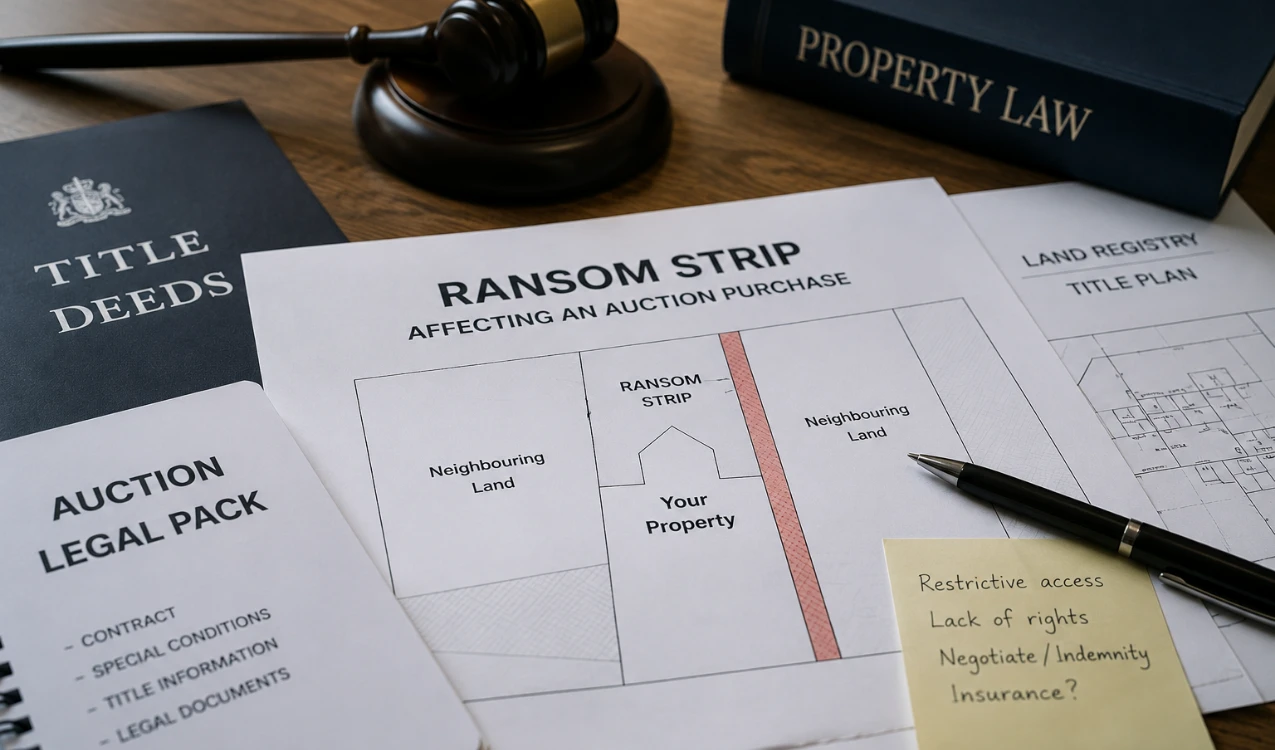
What is a ransom strip and how can it affect an auction purchase?
A ransom strip is a small piece of land, sometimes no wider than a garden path, that can quietly derail an otherwise straightforward auction purchase. If a ransom strip sits between your new site and the nearest road, or blocks the route for a driveway, drainage or utilities, its owner can effectively hold your project to ransom until you pay to cross it. Understanding the risk before you bid is the only reliable way to avoid an expensive surprise after the hammer falls.
At a private treaty sale, a buyer usually has several weeks to investigate the title, access and boundaries before committing. At auction, this process is compressed into just a few days, making a ransom strip purchase considerably riskier. Although the legal pack should disclose anything affecting ownership or access, a ransom strip can easily be overlooked unless someone checks for it specifically. Our guide explains what we check in an auction legal pack before a buyer commits to the purchase.
What is a ransom strip?
In simple terms, a ransom strip is a parcel of land, often owned by someone entirely unconnected to the site you’re buying, that lies between your property and a public highway, a service connection, or another piece of land you need to access. Because you can’t reach or develop your site without crossing it, the owner is in a position to demand a payment, sometimes a very large one, before granting you a right of way or agreeing to sell.
The strip itself can be tiny. Cases have involved gaps as narrow as 150mm between a boundary and the road, yet that sliver of land can be enough to block a driveway, prevent access for construction traffic, or stop utility companies from laying a connection. Size has very little bearing on how much leverage the owner holds. FA ransom strip that’s barely visible on a site visit can still be worth a substantial sum once it’s clear nothing can be built, connected, or even accessed without crossing it.
It’s worth distinguishing a ransom strip from a restrictive covenant, another common issue found in auction legal packs. Our guide to understanding restrictive covenants on a property explains the issue in more detail. A covenant restricts what you can do with land you already own, such as prohibiting certain uses or further development. A ransom strip is different: it is land you do not own but need in order to access or use your site.
How ransom strips typically arise
Ransom strips are created in a few common ways. Sometimes a previous landowner deliberately retained a narrow strip along a boundary when selling off the rest of a plot, anticipating that future development would need to cross it. In other cases, the strip is created entirely by accident, perhaps through a historic land sale, a boundary dispute, or simple poor planning decades earlier. Occasionally, an investor spots an unclaimed or overlooked strip near a promising development site and buys it specifically to extract a payment later.
Unregistered land adds another layer of complexity here: what unregistered land means for a buyer. Where a ransom strip has never been formally registered, tracking down its true owner can be difficult and slow, sometimes requiring detective work through old deeds or local records before negotiations can even begin. Whatever the origin, the effect is the same: whoever controls that strip of land controls access to the site above it, and a ransom strip auction purchase can turn into a costly negotiation if the strip isn’t identified before you bid.
Why ransom strips matter especially at property auctions
The speed of auction purchases raises the stakes
Buying at auction means the contract becomes binding the moment the hammer falls, with no opportunity to negotiate the price down once you discover a problem. If a ransom strip only comes to light after you’ve won the lot, you’re contractually committed to completing the purchase, whatever access difficulties the strip creates. This is very different from a private sale, where a buyer can walk away or renegotiate if a serious title issue emerges during their enquiries.
This is why reviewing the legal pack thoroughly before the auction date matters so much. A ransom strip auction purchase that looked like a bargain on paper can quickly become far more expensive once you’ve factored in the cost of buying access rights from a third party who knows you have very little choice but to pay. The auctioneer’s guide price rarely accounts for this kind of hidden liability, which is exactly why relying on the marketing photographs and the headline figure alone is a risky way to approach any site with development potential.

How to spot a ransom strip before you bid
Identifying a ransom strip requires a mix of desk-based research and, ideally, a site visit. The following checks should form part of any pre-auction due diligence:
- Search the Land Registry title plan for the site and the land immediately surrounding it, looking for any narrow, unregistered or oddly shaped parcels along the boundary
- Check whether the site has a legal right of way, or only a physical route across land you don’t own
- Walk the boundary in person, or instruct a surveyor to do so, rather than relying solely on plans
- Review the auction legal pack in detail for any special conditions referring to access, easements, or third-party land
- Ask the auctioneer or seller’s solicitor directly whether they are aware of any restrictions affecting access to the site
A thorough legal pack review is the single most reliable way to catch a ransom strip before it becomes your problem, since the special conditions of sale will often hint at access arrangements that aren’t obvious from the photographs or floor plan alone. Buyers who skip this step, often because auction timelines feel rushed, are the ones most likely to discover a ransom strip only after they’ve already exchanged.
You can also search the Land Registry’s own records directly if you want to check title information yourself. search property information at HM Land Registry before the auction, though a solicitor’s review will usually pick up on details a quick search alone might miss.
What legal issues can a ransom strip cause?
A ransom strip doesn’t just create an awkward negotiation, it can cause a genuine legal and financial headache once discovered. Common problems include:
- Access disputes, where you cannot physically or legally reach the site without the strip owner’s agreement
- Utility connection issues, since pipes, cables and drainage often need to cross the same strip of land
- Planning permission complications, as local authorities may require proof of secure access before granting consent
- Valuation disputes, where you and the strip owner disagree sharply on what a fair payment for access should be
- Ownership uncertainty, particularly with unregistered land, where it isn’t always obvious who actually owns the strip
Any one of these issues on its own can add months and significant cost to a development. Together, they explain why a ransom strip auction purchase deserves far more scrutiny than its size on a plan might suggest. Planning authorities in particular can be unforgiving on this point, often refusing to grant consent at all until a secure legal right of access has been demonstrated in writing.
Not sure whether your target auction lot has an access problem??
Speak to our team before the auction. Our solicitors can review the legal pack, flag anything that looks like a ransom strip or access restriction, and explain what it could mean for your bid before you commit.
How is a ransom strip valued?
There’s no fixed formula for pricing a ransom strip, and negotiations can vary enormously depending on how essential the strip is to your project. The starting point most valuers and solicitors refer back to is the 1961 case of Stokes v Cambridge Corporation, where the court decided a ransom strip was worth roughly one-third of the increase in value created by releasing access, after deducting the developer’s costs and profit. Later cases have awarded anywhere between a quarter and half of that uplift, so the one-third figure is a reference point rather than a rule.
In practice, the price you end up paying depends on how much bargaining power each side holds. If there’s a realistic alternative route to the site, the strip owner’s leverage weakens considerably. If the strip is the only viable access, and particularly if it was bought deliberately with this in mind, you may be facing a considerably steeper bill. Where several third-party owners each control a separate ransom strip on a larger site, every negotiation typically has to be conducted, and settled, separately, which can significantly extend both the timeline and the eventual cost.
Getting an experienced valuer and solicitor involved early gives you the best chance of reaching a commercially sensible figure, rather than being backed into an unfavourable one. Knowing roughly what a ransom strip might cost to resolve, before you bid, also allows you to build that figure into your maximum bid, rather than discovering it only once you’ve already won the lot.
What can you do if you discover a ransom strip after winning at auction?
Discovering a ransom strip after the hammer has fallen is far from ideal, but it isn’t necessarily fatal to your purchase. A few options are usually worth exploring:
- Negotiate directly with the strip owner for either a right of way or an outright purchase of the land
- Investigate whether an alternative access route exists, even if it’s less convenient, through adjoining land or a different boundary
- Consider a legal indemnity insurance policy, which can protect against certain access-related risks in some circumstances
- Explore land assembly, buying additional adjoining parcels to create a workable route where one doesn’t currently exist
- In rare, large-scale cases, ask whether a local authority might consider a compulsory purchase in the wider public interest
None of these options are quick or guaranteed, which is exactly why identifying a ransom strip before you bid, rather than negotiating your way out of one afterwards, is so much cheaper and less stressful. A ransom strip auction purchase handled with proper legal advice from the outset rarely ends up as expensive, in time or money, as one where the issue only surfaces after completion.
Frequently asked questions about ransom strips
Can a ransom strip affect a residential auction purchase, not just developers?
Yes. While ransom strips are most commonly discussed in relation to large development sites, they can just as easily affect someone buying a single plot, a self-build site, or even an existing house at auction where access crosses a neighbour’s land. Any buyer planning to extend, convert, or add a driveway should treat a ransom strip as a genuine risk, not just an issue for commercial developers.
Does every narrow strip of land next to a site count as a ransom strip?
Not necessarily. A strip only becomes a ransom strip if it’s genuinely needed for access, services, or development, and is owned separately from the site itself. Plenty of narrow boundary strips exist without ever affecting access or value. The key question is always whether the site can be reached, built on, or connected to services without crossing that particular piece of land.
How AuctionSolicitor can help protect you before you bid
Ransom strips are exactly the kind of issue a thorough legal pack review is designed to catch. Before you commit to bidding on a site with any development potential, having a solicitor check title, boundaries and access arrangements gives you a realistic picture of what you're buying, and what it might cost to unlock its full value. Our team reviews every auction legal pack with exactly this kind of hidden risk in mind, rather than treating the review as a formality to tick off before the sale. Whether you're buying a single plot or assembling several lots for a larger scheme, a quick conversation before auction day is almost always cheaper than untangling an access dispute afterwards.
