


What is the modern method of auction and how does it work?
The modern method of auction is a type of conditional auction that takes place entirely online over a period of around 30 days. It has grown significantly in popularity in the UK over the past decade, partly because it opens up property auction buying to people who need a mortgage, and partly because it gives sellers a higher level of certainty than a traditional estate agent sale without the speed constraints of a conventional auction room.
If you have seen a property listed on Rightmove or Zoopla through an iamsold, IAM Property, or similar platform with an online auction countdown, you have encountered the modern method of auction. Understanding how it works before you bid — or list — is essential, because the legal and financial commitments involved are quite different from both a standard property purchase and a traditional auction.
What is the modern method of auction?
The modern method of auction is sometimes called a conditional auction because it does not require contracts to exchange on auction day itself. Instead, the winning bidder pays a non-refundable reservation fee and then has a set period — typically 28 days — to exchange contracts, followed by a further 28 days to complete. This 56-day total window is long enough for most mortgage buyers to arrange their finance, which is why the modern method of auction attracts a much wider buyer pool than a traditional auction.
Bidding takes place online through the auction platform’s website, usually over a period of 30 days or more. Like eBay, bids can be placed at any point during the bidding window, and buyers can set a maximum bid and allow the platform to bid on their behalf incrementally up to that limit. The highest bid at the close of the auction wins, provided it meets the seller’s reserve price.
The format was pioneered largely by iamsold, the platform behind iamproperty, and is now used by auction houses and estate agents across the UK. Sellers typically pay no upfront fees — the costs are instead loaded onto the buyer through the reservation fee.
How does the modern method of auction work step by step?
Step 1 — the property is listed and marketed
The seller instructs an estate agent or specialist auction platform to list the property. It appears on Rightmove and Zoopla with an auction end date clearly displayed. A legal pack is prepared by the seller’s solicitors and made available online for prospective buyers to review before bidding.
Reviewing the legal pack before you bid is essential. It contains the title register, title plan, special conditions of sale, searches, and any relevant leasehold documentation. If there are problems with the title or onerous clauses buried in the special conditions, you will be committed to buying the property before discovering them if you skip this step. You can instruct an auction pack review before bidding to ensure you fully understand what you are buying.
Step 2 — bids are placed online
Buyers register with the auction platform and place bids during the auction window. The online format is intentionally accessible — buyers do not need to attend an auction room or bid against a crowd. Bids are typically placed in fixed increments, and the current highest bid is visible throughout.
Like traditional auctions, the modern method of auction includes a reserve price set by the seller. This figure is confidential and is the minimum the seller will accept. Properties do not sell if bidding does not reach the reserve, even if bids are placed.
Step 3 — the auction closes and the winning bidder pays a reservation fee
When the auction ends, the highest bidder wins. They are then required to pay a reservation fee — typically around 3% to 5% of the purchase price, plus VAT, subject to a minimum amount — directly to the auction platform. This fee is non-refundable if the buyer subsequently withdraws.
This is one of the most important features of the modern method of auction and one of the most misunderstood. The reservation fee is not a deposit. It does not form part of the purchase price. It is paid to the auction platform as a fee for reserving the property, and it is separate from — and in addition to — the standard 10% exchange deposit that the buyer will pay when contracts are exchanged. It is also subject to Stamp Duty Land Tax, which catches many buyers off guard.
Step 4 — exchange of contracts within 28 days
After paying the reservation fee, the buyer has 28 days to exchange contracts. This is where a solicitor specialising in auction conveyancing becomes critical. Auction timelines are legally binding and the deadlines are strict — extensions are sometimes possible but are not guaranteed and may involve additional costs.
The buyer’s solicitor will review the legal pack, raise any necessary enquiries, and handle the exchange. If the buyer does not exchange within 28 days without an agreed extension, they lose their reservation fee. For this reason, it is strongly advisable to instruct a solicitor before bidding, not after winning. You can read more about what the conveyancing process involves on our before you bid guide.
Step 5 — completion within a further 28 days
Completion must take place within 28 days of exchange — giving a total of 56 days from the auction end date to completion. This is long enough for most mortgage lenders to process an application, which is why the modern method of auction is accessible to buyers who are not cash purchasers.
If the buyer fails to complete after exchange, they risk losing not only the reservation fee but also the 10% exchange deposit and potentially face additional financial penalties. Sellers are similarly bound — if the seller withdraws after exchange, the buyer may be entitled to the reservation fee back along with other remedies.
Modern method of auction vs traditional auction
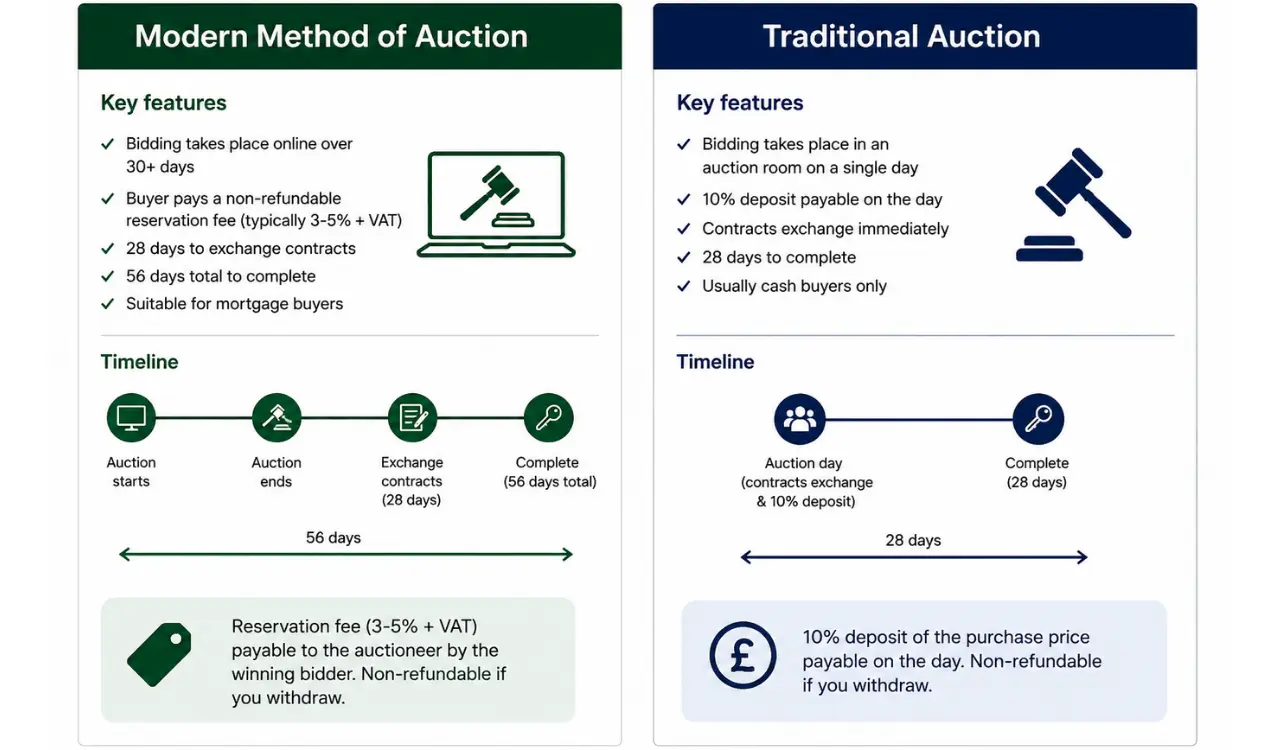
The table below summarises the key differences between the modern method of auction (conditional auction) and the traditional method.
| Factor | Modern method of auction | Traditional auction |
|---|---|---|
| Bidding format | Online, over 30+ days | Auction room, single day |
| Buyer commitment | Reservation fee (~5%) | 10% deposit, contracts exchange same day |
| Exchange deadline | 28 days after auction end | Immediate (auction day) |
| Completion deadline | 56 days total | 28 days from exchange |
| Mortgage buyers eligible? | Yes — 56 days allows mortgage completion | Rarely — 28 days usually too short |
| Reservation fee refundable? | No — lost if buyer withdraws | N/A (deposit used instead) |
| Sale fall-through rate | Lower than estate agent | Very low |
For a more detailed breakdown of both formats and help choosing the right one, see our guide on conditional vs unconditional auction.
Considering bidding on a property at modern method of auction?
The legal pack is available to review before you bid — and reviewing it is the single most important thing you can do to protect yourself. Our fixed-fee auction pack review gives you a clear picture of risks, special conditions, and hidden costs before you commit. Upload the pack here and we will turn it around within 24–72 hours.
Risks and drawbacks of the modern method of auction for buyers
The reservation fee is non-refundable and on top of the price
The most commonly raised concern about the modern method of auction is that the reservation fee is non-refundable and payable on top of the agreed sale price. A 4% reservation fee on a £250,000 property, for example, adds £10,000 to the buyer’s costs before solicitors’ fees, surveys, and Stamp Duty are even considered. Many buyers discover the scale of this fee only after winning.
The timelines are tight and legally binding
While 56 days is longer than the 28-day window of a traditional auction, it is still considerably shorter than the average estate agent transaction. Buyers need to have their finances in order, their solicitor instructed, and their survey arranged before bidding — not after. Treating the deadline as flexible is a costly mistake.
The legal pack may contain significant issues
Properties sold through the modern method of auction are not always straightforward. Short leases, restrictive covenants, missing planning consents, or onerous special conditions can all be present in the legal pack. Unlike an estate agent sale, there is no standard pre-contract enquiries process that surfaces these automatically — buyers must review the pack themselves or through a solicitor before bidding.
Not all mortgage lenders will lend on a 56-day timeline
While the modern method of auction is accessible in principle to mortgage buyers, in practice it depends on the lender. Some mortgage offers take longer than 56 days to produce. Buyers relying on a mortgage should confirm with their lender or broker that they can meet an auction completion deadline before bidding — not assume it is achievable.
The modern method of auction for sellers
From a seller’s perspective, the main appeal of the modern method of auction is a combination of speed, wider buyer reach, and a level of commitment from the buyer that a standard estate agent sale does not provide. Because the winning bidder pays a non-refundable reservation fee, they have a strong financial incentive to complete. Fall-through rates are significantly lower than in conventional sales.
Sellers typically pay no upfront listing fee — the auction platform earns its income from the buyer’s reservation fee. However, sellers still need to instruct a solicitor to prepare the legal pack before the auction opens. This is not optional and cannot wait until after the auction closes. A well-prepared legal pack speeds the conveyancing process significantly and reduces the risk of the sale collapsing due to legal issues emerging post-auction.
The seller sets a reserve price, which is the minimum they will accept. Properties do not complete if bidding does not reach this figure. The reserve is typically set at around 10% below the guide price, though this varies.
Do you need a solicitor for the modern method of auction?
Yes — both buyers and sellers need a solicitor experienced in auction conveyancing for a modern method of auction transaction. For buyers, instructing a solicitor before the auction closes — not after winning — is by far the most sensible approach. Once you have paid the reservation fee, the 28-day exchange clock is already running. Getting a solicitor up to speed in the days after winning costs time you cannot afford to waste.
For sellers, the legal pack must be prepared in advance. A solicitor familiar with auction timelines will draft the pack efficiently, include all necessary documents and searches, and be ready to move immediately once the auction closes and a buyer is confirmed. Conventional solicitors who are used to standard sale timescales are not always well-suited to auction work — the pace and the legal framework are different.
The iamproperty group is one of the largest operators of modern method of auction sales in the UK and publishes guidance on the process from their perspective as a platform provider. However, their guidance should not be a substitute for independent legal advice.
Need auction conveyancing support?
Whether you are buying or selling through the modern method of auction, our fixed-fee auction solicitors are built around auction timelines. We review legal packs before you bid, handle post-auction conveyancing at the pace the deadline demands, and draft legal packs for sellers ahead of auction day. Clear fees, no surprises.
