




Special conditions of sale: the auction pack clauses that could cost you thousands
The special conditions of sale are one of the most overlooked sections in any auction legal pack — and one of the most expensive to ignore. They are easy to miss, often written in dense legal language, and capable of adding thousands of pounds to the cost of a purchase before you have factored in stamp duty, your own legal fees, or any renovation work.
Every buyer receives an auction legal pack before the sale date. Inside that pack, alongside title registers and search results, sits a section that can transform the financial picture of a deal entirely. This article explains what the special conditions of sale actually are, identifies the clauses that cause buyers the most problems, and explains why a thorough auction pack review before bidding is not optional — it is the only reliable protection you have.
What are the special conditions of sale?
Every property auction contract operates under two sets of terms. The first is the General Conditions of Sale — a standardised framework that applies to all lots within the auction. These cover core obligations: how the deposit is paid, the default completion period, and what happens if either party fails to perform.
The special conditions of sale are different. They are drafted specifically for each individual lot by the seller’s solicitor, and they override the general conditions wherever there is a conflict. That means whatever the special conditions say is what applies to your purchase — not the default terms you might assume are in place.
The key point that catches buyers out is timing. The moment the auctioneer’s hammer falls, contracts are exchanged. You are legally bound. There is no cooling-off period, no chance to raise objections, and no scope to renegotiate. If you did not read the special conditions before bidding, you are bound by them regardless.
This is why a professional auction pack review carried out before the auction is so important. Reading the special conditions with legal guidance — and understanding what every clause means in practice — is the single most effective step any auction buyer can take to protect their position.
The special conditions of sale clauses that cost buyers the most
Some special conditions are entirely routine. They may confirm vacant possession, clarify how utilities are handled, or note that the property is being sold as seen after a survey. Others carry significant financial obligations that are not obvious from the guide price. The following are the clauses that create the most problems.
Buyer’s premium and seller’s legal costs
A buyer’s premium is a fee payable to the auctioneer on top of the hammer price. It typically sits between 2% and 5% of the purchase price, plus VAT. On a property that falls at £200,000, that is up to £12,000 in additional costs before any other fee is considered.
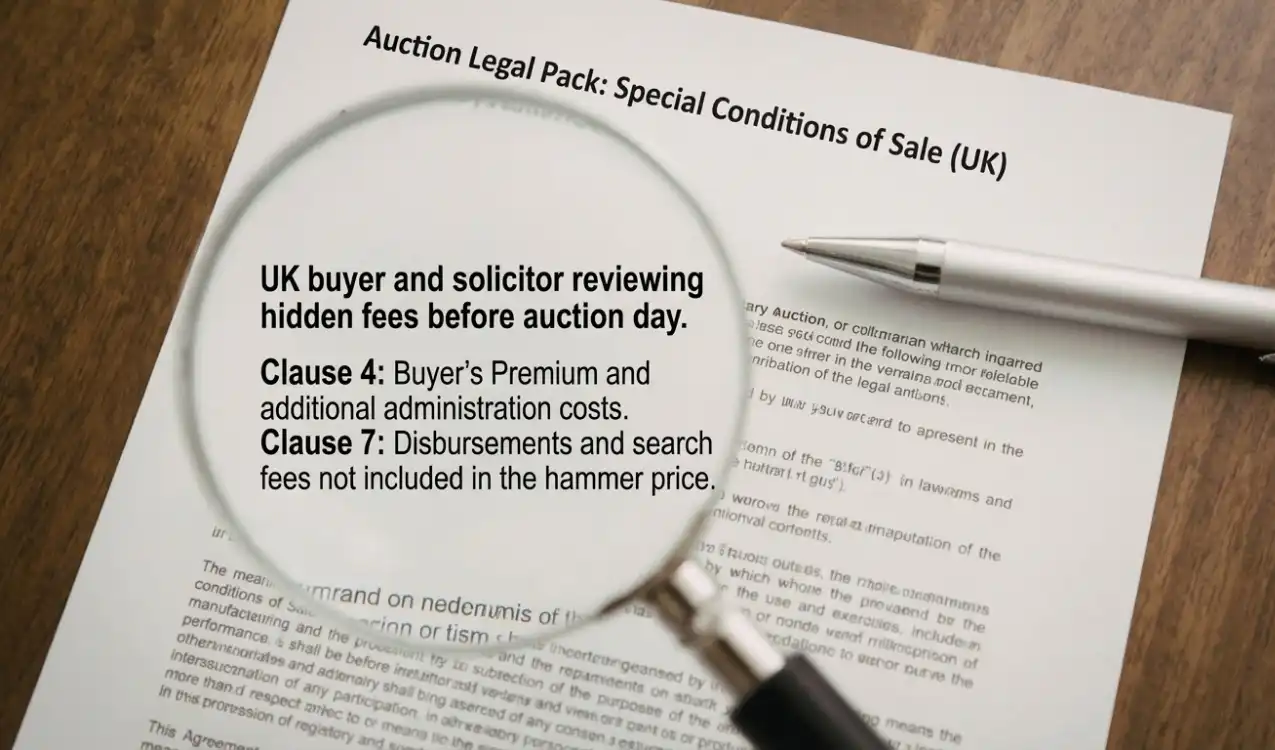
Beyond the buyer’s premium, the special conditions of sale frequently require the buyer to reimburse the seller’s solicitor’s fees, conveyancing search fees, and administrative charges. These can reach several thousand pounds independently. Add them together and the real cost of the purchase is often materially higher than the hammer price alone.
Shortened completion periods
The standard completion window in the auction legal pack is 28 days. Special conditions often reduce this to 14 days — or less. For buyers using bridging finance or a mortgage, this creates significant pressure on both the lender and the legal team. Missing the deadline risks losing the 10% deposit and may expose the buyer to further liability if the property is resold at a lower price.
Before bidding on any lot with a shortened completion period, confirm with your solicitor and lender that the timetable is achievable. Do not assume it will be fine — the consequences of getting this wrong are severe.
Outstanding service charges and Section 20 notices
Leasehold properties at auction frequently carry arrears of service charges or ground rent, and the special conditions of sale will typically transfer these to the buyer on or before completion. A leasehold property that appears affordable at the guide price can carry thousands in inherited arrears.
Equally serious are Section 20 notices, which warn of forthcoming major works to the building. Even if works have not yet begun, a Section 20 notice in the legal pack means the buyer may be liable for a significant share of repair or renovation costs shortly after taking ownership. These notices are sometimes absent from incomplete legal packs — another reason why a full review before the auction is necessary.
Indemnity insurance clauses
Where a property has a title defect — missing planning permission, absent building regulations certificates, or an unresolved right of way — the seller’s solicitor may insert a clause requiring the buyer to take out an indemnity insurance policy. The policy covers the financial risk arising from the defect, but it does not fix the defect.
Buyers who proceed without understanding what the indemnity covers may find that the special conditions of sale have effectively transferred a legal problem from the seller to them — along with responsibility for managing it.
Vacant possession and occupancy clauses
A property sold without a guarantee of vacant possession may be occupied by sitting tenants, family members, or informal occupants with enforceable rights. In the most difficult cases, this can mean expensive and time-consuming legal proceedings before the buyer can access or let the property.
Always check whether the special conditions confirm vacant possession. If the wording is ambiguous or silent on the issue, clarify this with your solicitor before the auction — not after.
Overage and clawback clauses
Overage clauses — sometimes called clawback provisions — entitle the seller to a further payment if a specified event occurs after completion. This is most commonly triggered by planning permission being granted for development, an extension, or a change of use. The overage percentage and duration vary, but these clauses can bind the property for 20 years or more.
For buyers intending to develop, extend, or improve a property, an overage clause can fundamentally alter the financial case. The special conditions will set out the trigger, the payment calculation, and the duration — all of which need careful analysis before you bid.
Why the auction legal pack must be reviewed before you bid
The special conditions of sale become binding the moment the hammer falls. There is no review period, no negotiation window, and no mechanism for raising objections once the contract is exchanged. If you did not understand a clause before bidding, you are still bound by it.
A professional review of the auction legal pack before the auction does several things that reading the pack yourself cannot replicate. An experienced auction solicitor will identify clauses that appear routine but carry significant risk. They will flag documents that are missing from the pack and should be requested before the sale. They will also advise on whether any issue they identify is manageable within your timeline and budget, or whether it makes the lot unsuitable for the finance or purpose you have in mind.
For buyers approaching their first auction, our guide on what to do before bidding at property auction sets out the full preparation process in plain terms. The legal pack review sits at the centre of that process — and the special conditions are the section that demands the closest attention.
There are specific situations where the stakes of skipping a review are especially high:
- Leasehold properties, where service charge arrears, Section 20 notices, short leases, and ground rent review clauses can each independently affect affordability and mortgageability
- Lots listed as “cash buyers only” — a phrase that signals the pack likely contains something a mainstream lender would decline, whether a title defect, habitability issue, or unresolved legal matter
- Properties offered well below apparent market value, where the discount almost always reflects a problem that is documented somewhere in the legal pack
Any lot with a completion period shorter than the standard 28 days, where the deadline must be confirmed as achievable before a bid is placed
Unsure about the special conditions in the legal pack?
Special conditions of sale can add hidden fees, shorten completion deadlines, or transfer legal risks to the buyer. Arrange a pack review before auction day so you understand the real costs and obligations.
What else the auction legal pack contains beyond the special conditions
The special conditions of sale attract the most attention in the context of hidden costs and obligations, but a complete review of the auction legal pack covers several other areas that carry their own risks.
Title register and title plan
The title register confirms ownership, identifies any charges that must be discharged on completion, and shows whether any restrictive covenants or rights of way affect the property. A possessory or qualified title carries greater risk than an absolute title — and needs careful legal assessment before purchase.
Property searches
A complete auction legal pack includes local authority, drainage, and environmental searches. These reveal planning enforcement notices, drainage arrangements, flood risk, and contamination history. Where searches are absent from the auction legal pack, the buyer must decide whether to commission their own — often against a tight timetable — or proceed without them and accept the associated risk.
Leasehold documents
For leasehold properties, the legal pack should contain the lease itself, recent service charge accounts, the LPE1 management information form, and details of any upcoming major works. Leases below 80 years require careful attention — they affect mortgageability and trigger the more complex and expensive lease extension process.
Planning and building regulations history
Extensions and conversions require planning permission and building regulations sign-off. Where these certificates are absent, the risk falls on the buyer — either through an indemnity policy or, in more serious cases, through potential enforcement action by the local authority.
Working out the true cost before you bid
Once you have a clear picture of the special conditions of sale and the rest of the legal pack, the next step is to calculate the true cost of the purchase. This is the only basis on which you can set a rational maximum bid.
Work through the following checklist before committing to a bidding limit:
- List every fee in the special conditions that the buyer is required to pay: buyer’s premium, seller’s legal fees, search reimbursements, and administration charges
- Establish the total of any service charge or ground rent arrears that will pass to you on completion, and check for Section 20 notices indicating upcoming works
- Confirm the completion period and verify with your solicitor and lender that it is achievable — if it is not, the lot may not be suitable
- Assess any overage clause, restrictive covenant, or access issue that affects what you can do with the property and how easily you can resell it
- Add stamp duty land tax, your own legal fees, survey or valuation costs, and any finance arrangement fees to arrive at total acquisition cost
Subtract that total acquisition cost from the realistic value of the property to establish the maximum hammer price that makes commercial sense. Bidding above that figure — even slightly — is where the numbers stop working.
How AuctionSolicitor can help with the special conditions and the legal pack
AuctionSolicitor works exclusively with auction buyers and sellers. That focus means our solicitors are familiar with every variety of special conditions of sale clause — from buyer’s premiums and shortened completions through to complex overage provisions and leasehold pitfalls. We do not approach the legal pack as a formality before the real work begins. The pack review is the foundation on which the entire transaction rests.
When you use our auction pack review service, we analyse every clause in the special conditions, cross-reference with the title documents and searches, and identify any issues that need resolution — or that should change your bidding decision entirely. Buyers who go on to win their lot benefit from the fact that we already know the pack in detail, which means the post-auction conveyancing can progress without losing time to initial document review.
For buyers who win the auction and need fast, deadline-led conveyancing, our buying at auction conveyancing service is structured to meet tight completion windows. We manage the legal work from exchange through to completion, keeping your transaction on schedule from day one.
Get proper legal advice before the hammer falls
The special conditions of sale will not wait for you to read them after the auction. They take effect the moment you win. The only moment that matters is before you bid — and the most effective use of that time is a thorough review with an experienced auction solicitor.
If you have an auction legal pack you would like reviewed before the sale, you can get a fixed fee quote and instruct us online. If you would prefer to discuss your situation first, our team is available to talk through the process with you. We act for buyers and sellers across England and Wales and turn auction pack reviews around quickly — because in this market, time is always the constraint.
Need help reviewing an auction legal pack?
The special conditions of sale can include buyer premiums, legal cost reimbursements, shortened completion periods and other clauses that significantly affect the price and risk of a property purchase. Our solicitors review the auction legal pack before you bid so you know exactly what you are agreeing to.
