

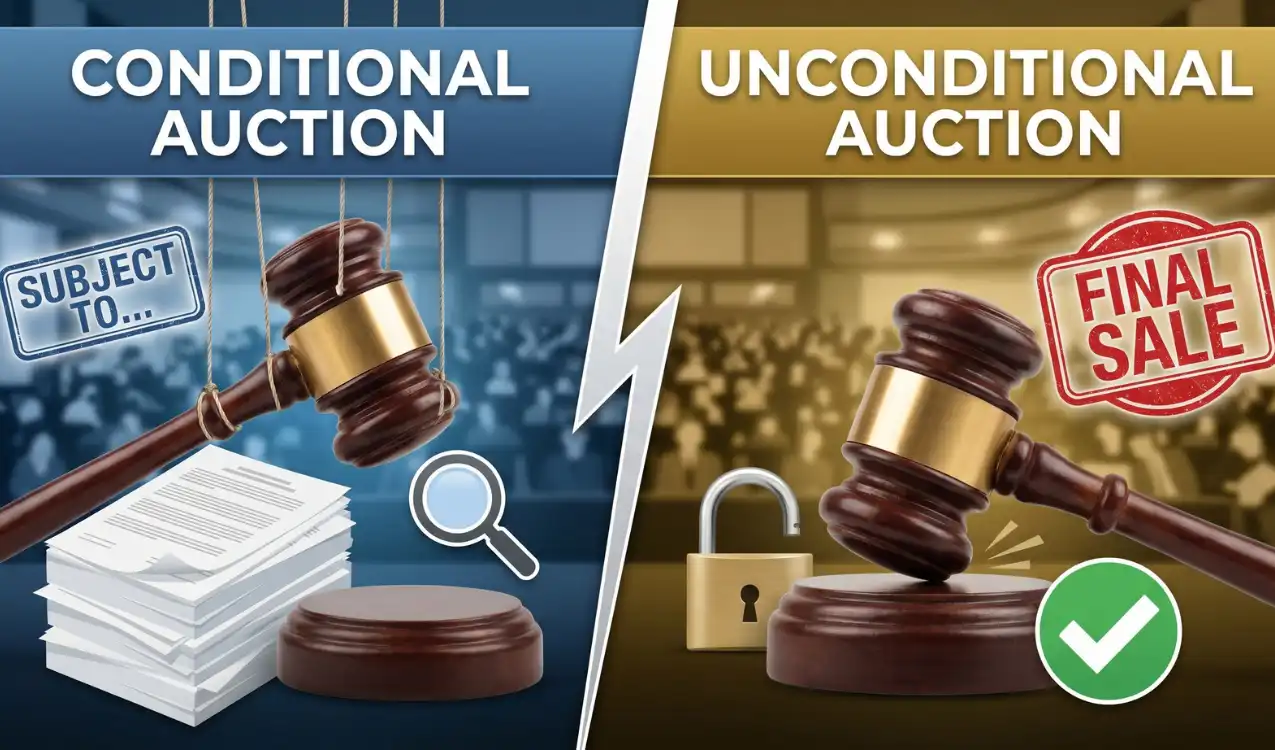
Conditional vs unconditional auction: which type of sale are you actually entering?
The difference between a conditional vs unconditional auction is one of the most important things a property buyer needs to understand — and one of the least well explained. Many buyers register for an auction, win the lot, and only then discover that the legal obligations they have taken on are completely different from what they expected.
In an unconditional auction, you exchange contracts the moment the hammer falls. In a conditional auction — also known as the modern method of auction — you enter a reservation period that gives you time to arrange a mortgage, carry out due diligence, and exchange contracts later. The two formats look similar from the outside. The legal consequences of winning a bid are entirely different.
This guide explains exactly how each type of auction works, what you are committed to at each stage, how the reservation fee auction process differs from the traditional deposit model, and how to tell which format you are actually entering before you raise your paddle.
What is an unconditional auction?
An unconditional auction — also called a traditional auction — is the format most people picture when they think of property auctions. It is fast, legally binding, and leaves no room for doubt about what happens when the hammer falls.
The moment the auctioneer’s gavel comes down and the lot is declared sold, exchange of contracts takes place immediately. The buyer and seller are legally bound to complete the transaction. There is no cooling-off period, no opportunity to renegotiate, and no ability to withdraw without triggering serious financial and legal consequences.
On the day, the winning bidder is required to pay:
- A 10% deposit — held as security against the buyer’s obligations and counted towards the purchase price
- A buyer’s fee or administration charge — payable to the auction house, typically a fixed amount or a percentage of the hammer price, and not counted towards the purchase price
Completion — the transfer of the remaining 90% and legal title — must follow within the timeframe specified in the auction conditions. Most unconditional auctions set this at 28 days, though some extend to 30 or 35 days depending on the auction house.
What makes the unconditional format particularly unforgiving is the consequence of failure to complete. If the buyer cannot complete by the deadline, they lose their deposit, remain liable for any losses the seller suffers as a result, and face the prospect of legal proceedings. The detail of what actually happens legally if a buyer cannot follow through is something every bidder should understand before they bid — our guide to pulling out after winning a property auction sets out the full legal consequences.
What is a conditional auction — and what is the modern method of auction?
A conditional auction operates under a fundamentally different set of rules. The modern method of auction — as it is widely marketed by online auction platforms and estate agencies — is a conditional format designed to attract a broader pool of buyers, including those relying on mortgage finance.
When the hammer falls in a conditional auction, the winning bidder does not exchange contracts immediately. Instead, they enter a reservation period — typically 28 days — during which they have the exclusive right to proceed with the purchase. No one else can buy the property during this time, and the seller cannot accept another offer. But the buyer is not yet legally bound to complete.
During the reservation period, the buyer can carry out their survey, instruct their solicitor to review the legal pack, arrange mortgage finance, and raise any legal enquiries. If everything proceeds satisfactorily, contracts are exchanged at the end of the 28-day reservation period, and the buyer then has a further 28 days to complete — giving a total timeline of approximately 56 days from the auction to completion.
On auction day, instead of a 10% deposit, the winning bidder pays a reservation fee auction charge. This is typically up to 5% of the purchase price, or a fixed minimum (often around £5,000 to £6,000), whichever is higher. This fee is non-refundable and does not form part of the purchase price — it is paid in addition to it. If the buyer decides not to proceed during the reservation period, they lose the reservation fee but are not otherwise liable for the seller’s losses.

Conditional vs unconditional auction: a side-by-side comparison
The table below summarises the key differences between a conditional vs unconditional auction across all the factors that matter most to buyers:
| Feature | Unconditional auction | Conditional auction (modern method) |
|---|---|---|
| Legally binding? | Immediately — at the fall of the hammer | Not immediately — after the reservation period |
| Payment on the day | 10% deposit (counts towards purchase price) | Non-refundable reservation fee (does not count towards price) |
| Completion timeline | Typically 28 days | Typically 56 days (28 to exchange + 28 to complete) |
| Can the buyer exit? | No — breach of contract; deposit forfeited | Yes — but reservation fee is lost |
| Mortgage possible? | Very difficult — 28 days is too tight for most lenders | Yes — 56 days usually gives enough time |
| Best suited to | Cash buyers, developers, investors | Residential buyers, first-time buyers, mortgage purchasers |
| Seller certainty | High — sale cannot fall through once hammer falls | Lower — buyer can choose not to proceed |
The single most important distinction is the first row: legal binding. In an unconditional auction, you are bound the moment you win. In a conditional auction, you have time to reconsider — but that flexibility comes at a price, and that price is the non-refundable reservation fee.
Unsure which type of auction you are entering?
A pre-auction legal pack review can clarify whether you are facing an unconditional 10% deposit or a conditional reservation fee, and help you spot binding special conditions before you commit. Request a legal pack review before bidding
The reservation fee auction model: what buyers need to understand
The reservation fee is one of the most misunderstood elements of the modern method of auction, and it regularly catches buyers off guard. It is important to understand it clearly before bidding.
The reservation fee is not a deposit in the traditional sense. It does not reduce the amount you need to pay at completion. If you buy a property at conditional auction for £200,000 and pay a reservation fee of £6,000 on the day, you will still need to pay the full £200,000 at completion. The reservation fee is an additional cost, payable to secure your exclusivity period — and it is forfeited in full if you choose not to proceed.
Where the reservation fee goes depends on the auction house. Some pass it to the seller. Others retain it as their fee for the auction service. Either way, it is gone the moment it is paid. Buyers need to budget for this on top of all other purchase costs: the purchase price itself, stamp duty, legal fees, survey costs, and any additional fees specified in the special conditions of sale.
For buyers using mortgage finance, understanding the timing is critical. The 28-day reservation period is designed to give lenders enough time to process a mortgage application, carry out their valuation, and issue a formal offer — but it is tight. Whether 28 days is actually achievable with your specific lender and mortgage product depends on the lender’s current processing times and the type of property involved. Our guide to whether you need cash to buy a property at auction explains the options for buyers who are not cash purchasers.
How to tell which type of auction you are entering
The listing particulars and the legal pack will always confirm which type of auction applies to a given property — but you need to know what to look for.
If you are entering an unconditional auction, the documentation will refer to the exchange of contracts taking place on the day of sale, the payment of a 10% deposit at the fall of the hammer, and a completion deadline of 28 days. The terms will make clear that the contract is immediately legally binding.
If you are entering a conditional auction under the modern method of auction, the documentation will refer to a reservation agreement rather than a contract of sale, a reservation fee rather than a deposit, and an exclusivity period of 28 days before exchange of contracts. The terms will specify that the reservation fee is non-refundable and does not count towards the purchase price.
In practice, the quickest way to identify the format is:
- If the listing mentions a “non-refundable reservation fee” and “56 days” total: you are looking at a conditional auction.
- If the listing requires a “10% deposit” and exchange of contracts on the day: you are looking at an unconditional auction.
- If the platform is primarily online and marketed to residential buyers: it is likely — though not certain — to be the modern method of auction (conditional).
- If the auction is a live room event run by a traditional auctioneer: it is likely — though again not certain — to be unconditional.
Always confirm by reading the auction terms, the special conditions of sale, and the reservation or contract documentation before you register to bid. If you are uncertain, ask the auctioneer directly.
What sellers need to know about the choice between conditional and unconditional
The choice between conditional vs unconditional auction is not just a buyer’s consideration. For sellers, the two formats carry very different levels of certainty — and that difference matters significantly.
An unconditional auction delivers the highest level of certainty a seller can achieve. Once the hammer falls, the buyer is legally bound and the deposit is held as security. The only realistic ways the sale fails to complete are if the buyer is unable to raise funds and accepts the financial penalty of forfeiture, or if a title defect emerges that was not disclosed in the legal pack. These scenarios do occur, but they are relatively uncommon.
A conditional auction delivers a lower level of certainty. The successful bidder has entered a reservation period during which they can choose not to proceed — losing their reservation fee, but without any further legal exposure. For a seller who wants absolute certainty of sale, the conditional format carries a material risk that the buyer will exercise this exit right. Some sellers will accept this tradeoff in exchange for access to a wider pool of buyers — particularly those using mortgage finance — and potentially a higher final price.
The type of property also influences which format is more appropriate. Properties that are unmortgageable — due to structural issues, unusual construction, or legal complications — attract cash buyers and investors who are comfortable with unconditional terms. Properties that are in good order and would appeal to owner-occupiers or first-time buyers may achieve better results through the modern method of auction, where the broader buyer pool includes those who need mortgage time.
Why the legal pack matters regardless of which format applies
Whether you are bidding in a conditional or unconditional auction, the legal pack is the single most important document you should review before you bid. The auction format determines when you become legally committed and how much flexibility you have — but the legal pack determines what exactly you are committing to.
The legal pack contains the title register, any searches carried out, the special conditions of sale, tenancy documents if the property is occupied, and evidence of planning history and building regulations. In a conditional auction, you have the reservation period to raise legal enquiries after the event — but the special conditions of sale become binding immediately upon payment of the reservation fee, and those conditions can impose significant additional costs and obligations that you will have no power to negotiate after the fact.
Special conditions are where many auction buyers encounter their most expensive surprises. They can require the buyer to pay the seller’s legal costs, indemnify the seller against specific liabilities, or complete in a shorter timeframe than the standard conditions allow. In both conditional and unconditional auctions, these terms are locked in. Our detailed guide to special conditions of sale and what they mean for auction buyers explains exactly what to look for and which clauses carry the most risk.
Independent property buyers’ bodies, including the National Association of Property Buyers (NAPB), consistently recommend that all buyers — conditional or unconditional — have the legal pack reviewed by a specialist solicitor before bidding. This is not cautious advice for nervous buyers. It is the standard practice of every experienced auction participant.
Get the legal pack reviewed before you bid on either type
Understanding the difference between a conditional vs unconditional auction is essential — but it is only the starting point. Knowing which format applies tells you when you become legally bound and what flexibility you retain. Reviewing the legal pack before you bid tells you what you are actually committing to buy, what the special conditions require of you, and whether there are any legal risks that should affect your bidding decision.
At Auction Solicitor, we review legal packs for buyers across England and Wales for both conditional and unconditional auctions. We provide a clear, plain-English assessment of the title, the special conditions, the searches, and any risks you need to understand before you bid — with a fixed fee and fast turnaround designed to fit within the tight timescales that all auction transactions demand.
If you have a legal pack you would like reviewed ahead of an upcoming auction, our auction pack review service gives you the information you need to bid with confidence and avoid the surprises that catch unprepared buyers at every type of auction.
Don’t bid without understanding your legal commitments
The auction format determines exactly when you become legally bound. Before you register to bid, have the auction legal pack reviewed by a specialist so you fully understand the completion timelines, non-refundable fees, and any expensive surprises hidden within the special conditions of sale.
