

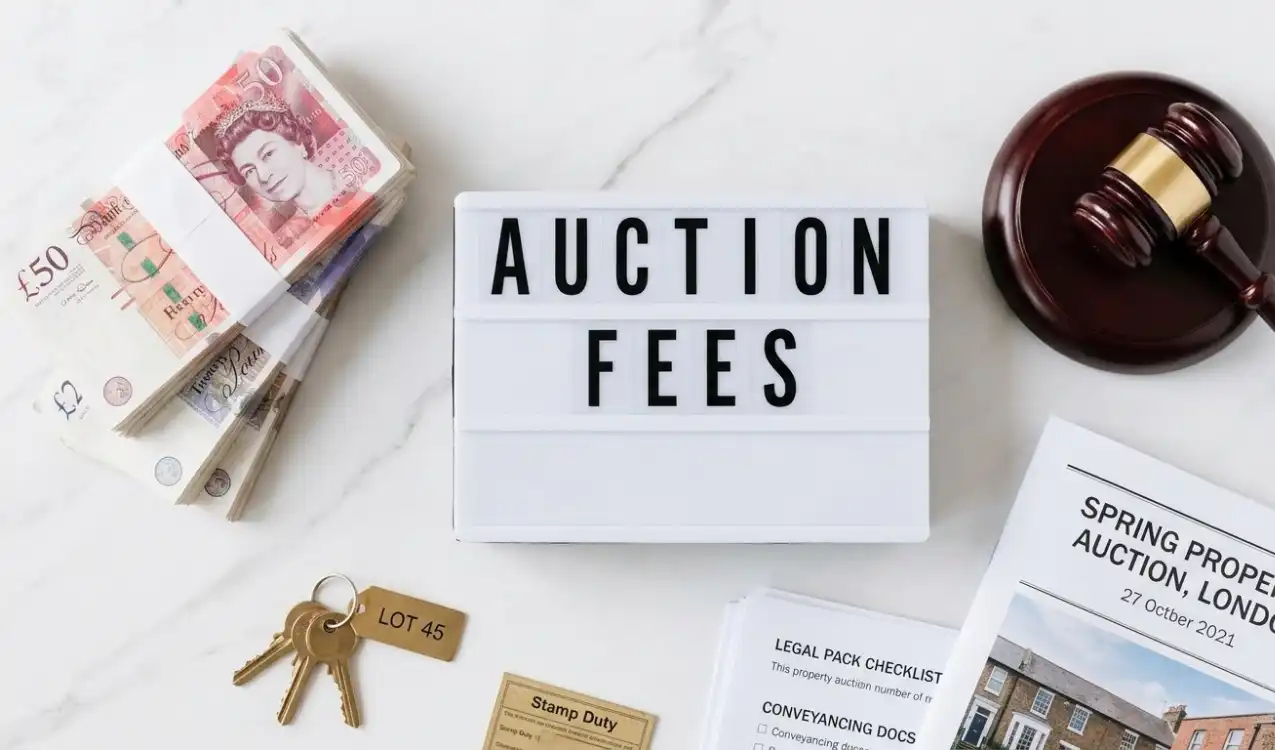
What fees do you pay when buying at property auction? The full breakdown
Property auction fees are one of the most misunderstood aspects of buying at auction in the UK. Many buyers set a budget based solely on the hammer price — the amount they expect to win for — without accounting for the several additional costs that apply on the day and at completion.
Unlike a conventional property purchase, auction transactions bind you legally the moment the gavel falls. There is no post-exchange period to negotiate away unexpected charges, and no opportunity to walk away once contracts have exchanged. Every cost associated with the purchase — whether obvious or buried deep inside the auction legal pack — becomes your legal obligation immediately.
This guide sets out every category of property auction fees a buyer in the UK should account for before raising their hand to bid, from the deposit paid on the day through to taxes, legal fees, and the charges that are most commonly overlooked.
Why the hammer price is never the final figure
The hammer price is the amount at which a lot is sold when the auctioneer’s gavel falls. It is the starting point for your total acquisition cost, not the end point. A range of additional property auction fees and charges sit on top of it — some standard across every purchase, others specific to the individual lot.
What makes this particularly important in an auction context is that all these charges are legally binding from the moment exchange takes place. The auction buyer costs are set out in the auction legal pack and, more specifically, in the special conditions of sale for each lot. A buyer who has not reviewed those documents before bidding may discover costs they had not anticipated only after the hammer has fallen — at which point those costs are entirely non-negotiable. A detailed explanation of typical auction buyer costs and taxes is covered in the full breakdown of auction costs and taxes, which sets out each charge category in full.
The 10% deposit: what you pay on auction day
The largest single payment most buyers make on auction day is the deposit — almost universally set at 10% of the hammer price. This must be paid immediately on the day, before you leave the auction room or, in an online auction, within the time specified in the auction terms.
The deposit cannot come from mortgage funds. If you are financing your purchase with a mortgage or a bridging loan, those funds will not be available on auction day — you need to have the 10% available from your own resources. Failure to pay the deposit means you have not completed your legal obligations under the contract, and the seller is entitled to forfeit your registration and pursue you for losses.
The deposit is held by the auctioneer and is typically released to the seller on completion. It does not accrue interest for the buyer during the period between auction day and completion, so buyers should bear this in mind when calculating the short-term cost of the purchase.
Administration fees and buyer’s premium
Almost all UK property auctions charge an administration fee to the buyer on top of the deposit. This is paid directly to the auction house — not the seller — and is non-refundable regardless of the outcome of the transaction. Administration fees typically range from £500 to £1,500 plus VAT, though they can be higher on commercial or higher-value lots.
The administration fee is a fixed property auction fee, payable on auction day alongside the deposit. It needs to be budgeted for separately from your maximum bid, as it is charged in addition to the hammer price.
Some auction houses also charge a buyer’s premium — an additional fee calculated as a percentage of the hammer price. This differs from the administration fee in that it scales with the property value. A buyer’s premium of 1.5% on a £250,000 property produces an extra £3,750 in auction buyer costs before any other charges are considered. Where applicable, the buyer’s premium will be stated clearly in the auction terms and the special conditions of sale. It is a legally binding obligation that arises automatically upon exchange.
Solicitor’s fees: auction pack review and conveyancing
Two categories of legal fees apply to most auction purchases. The first is the pre-auction pack review — the cost of having a solicitor examine the auction legal pack, the special conditions of sale, and all associated documents before you bid. The second is the conveyancing fee for managing the legal completion of the purchase after the hammer falls.
Pre-auction legal pack review
Reviewing the auction legal pack before bidding is not a legal requirement — but it is one of the most important things a buyer can do. The pack contains the title documents, search results, special conditions of sale, lease documents (for leasehold properties), and planning history. Problems that are not identified before exchange become the buyer’s problem after it.
A specialist solicitor’s auction pack review service will identify every cost obligation in the pack, flag legal risks in the title or lease, and produce a clear report before you bid. This is the only reliable way to know what your total auction buyer costs will be before you commit.
Conveyancing fees after the hammer
Once the hammer falls, you need a solicitor to handle the legal completion of your purchase within the completion window set out in the special conditions of sale — typically 20 to 28 working days. Auction conveyancing operates under significantly tighter timescales than standard residential conveyancing, which means experience in auction transactions is essential.
Conveyancing fees for auction purchases vary depending on the property value, whether it is leasehold or freehold, and the complexity of the legal pack. Fixed-fee options are available from specialist auction solicitors and provide certainty on this element of the auction buyer costs from the outset.

Stamp Duty Land Tax on auction properties
Stamp Duty Land Tax (SDLT) applies to all qualifying property purchases in England and Northern Ireland regardless of how the transaction is structured. Buying at auction does not change your SDLT liability — the rates, thresholds, and exemptions are identical to any other purchase. What does change is the timeline: SDLT must be filed and paid within 14 days of completion, and in an auction that completion typically happens within a few weeks of the auction day.
The rates applicable to your purchase depend on your circumstances. Standard rates apply to most buyers purchasing their only or main home. First-time buyer relief reduces the SDLT payable on purchases up to £500,000 (with a nil-rate threshold of £300,000 from April 2025). An additional 3% surcharge applies on every purchase where the buyer already owns a residential property — a significant extra cost that is often underestimated in the pre-bid budget.
For commercial and mixed-use auction lots, a separate, generally lower SDLT rate structure applies. Whether a property is classified as residential, non-residential, or mixed-use for SDLT purposes can meaningfully affect the tax liability, and this is a point worth confirming with your solicitor before bidding. A full explanation of how stamp duty works in an auction context is set out in the article on stamp duty on auction property, which covers the rates, surcharges, and calculation rules in detail.
SDLT is calculated on the total chargeable consideration — not just the hammer price. If the special conditions of sale require the buyer to pay any amount that forms part of the legal consideration for the property, that amount may be included in the SDLT calculation. The current government guidance on Stamp Duty Land Tax rates and thresholds provides the definitive position on applicable rates and reliefs for each buyer category.
Checked the special conditions of sale yet?
Hidden auction buyer costs are often buried in the legal pack. A solicitor review highlights extra fees, seller cost transfers, VAT exposure, and completion risks before you commit. Request a pre-auction pack review
Costs buried in the special conditions of sale
The most commonly overlooked property auction fees are those that are not charged by the auction house at all — they are obligations imposed on the buyer by the special conditions of sale within the auction legal pack. These vary from lot to lot and can add hundreds or thousands of pounds to the total cost of acquisition.
Special conditions of sale are legally binding additions to the standard auction contract, prepared by the seller’s solicitor and included in the legal pack. They override the standard auction terms where they conflict, and they apply automatically upon exchange. A buyer who has not read them carefully before bidding is agreeing to conditions they may not fully understand.
Common charges found in the special conditions of sale that increase the total auction buyer costs include:
- Seller’s legal fees: The buyer may be required to contribute to the seller’s solicitor’s costs for preparing the auction legal pack, including the cost of searches and disbursements.
- Auction house fees passed to the buyer: In some lots, the commission payable by the seller to the auction house is partly or wholly transferred to the buyer through the special conditions of sale.
- VAT on the purchase price: Commercial properties and some mixed-use lots may be subject to VAT at 20% if the seller has opted to tax. This is a substantial additional cost that must be identified before bidding.
- Indemnity insurance premiums: Where a title defect or missing consent exists, the special conditions may require the buyer to obtain and pay for indemnity insurance.
- Management pack and registration fees: For leasehold properties, the cost of obtaining a leasehold property enquiry pack from the managing agent, or paying a registration fee to the management company, may fall to the buyer.
- Deed of covenant costs: Some leasehold transactions require the buyer to enter into a formal covenant with the freeholder or management company — the legal costs of which may be passed to the buyer in the special conditions of sale.
Understanding the full scope of what special conditions of sale can impose is one of the most valuable things a pre-auction solicitor review delivers. A thorough guide to hidden costs at auction explains each of these categories in detail and shows how they affect the total acquisition cost for a typical residential or commercial lot.
Leasehold-specific costs: ground rent, service charges, and apportionments
Leasehold properties make up a significant proportion of auction lots, particularly in city centres and blocks of flats. When buying a leasehold property at auction, a category of additional costs applies that freehold buyers do not face: apportioned sums.
Apportionments are amounts relating to the ongoing financial obligations of the lease that are divided between the seller and buyer based on the completion date. These can include ground rent (the annual payment to the freeholder), service charge contributions (towards the maintenance and insurance of the building), and any advance premiums or reserve fund contributions already paid by the seller for a period extending beyond completion.
In some cases — particularly where large service charge demands have recently been issued, or where significant arrears have accumulated — apportioned sums can represent a meaningful additional property auction fee at completion. These figures are not always immediately visible in the auction catalogue; they require a review of the lease, the service charge accounts, and the special conditions of sale to calculate accurately.
Completion interest: the cost of missing the deadline
One of the most serious property auction fees — and the one buyers are least likely to have anticipated — is completion interest. Most auction contracts include a provision that if completion does not occur on the contractual completion date, the buyer is liable to pay interest on the outstanding balance for every day beyond that date.
Completion interest rates vary, but they are commonly set at a rate significantly above the Bank of England base rate — often 4% to 6% above it. On a £200,000 outstanding balance, even a week’s delay can generate hundreds of pounds in additional auction buyer costs. A month’s delay on a higher-value commercial lot can result in thousands.
The interest rate, the completion date, and the mechanics of the interest calculation will be set out in the special conditions of sale. This is one of the reasons why instructing a specialist auction conveyancing solicitor immediately after winning — not a day or two later — is so critical. Every day without a solicitor in place is a day closer to the deadline with no legal work started.
A complete checklist of property auction fees to budget for
Before placing any bid at auction, every buyer should construct a full cost schedule. The following list covers every typical category of property auction fees and auction buyer costs that should be included:
- 10% deposit — payable on auction day, from your own funds, not mortgage proceeds
- Auction administration fee — fixed charge from the auction house, typically £500–£1,500 plus VAT, payable on the day
- Buyer’s premium — percentage of the hammer price where charged, stated in the special conditions of sale
- Pre-auction legal pack review fee — solicitor’s charge for reviewing the pack and special conditions before you bid
- Auction conveyancing fee — solicitor’s charge for managing the legal completion post-hammer
- Disbursements — Land Registry fees, bank transfer fees, and any additional searches required post-exchange
- Stamp Duty Land Tax — at the rate applicable to your circumstances, calculated on the total chargeable consideration
- Seller’s legal fees — where required by the special conditions of sale
- VAT on the purchase price — on commercial or opted-to-tax properties
- Apportioned sums — ground rent, service charges, and insurance where the property is leasehold
- Indemnity insurance, management pack fees, deed of covenant costs — as required by the special conditions of sale
- Completion interest — if completion does not occur on the contractual date
Working through this list against the specific lot you are considering — using information drawn from the auction legal pack and special conditions of sale — will give you an accurate total acquisition cost before you bid. Setting your maximum bid based on the hammer price alone, without accounting for these additional charges, is one of the most common and costly mistakes auction buyers make.
How to identify all costs before auction day
The single most effective step any auction buyer can take to understand their total property auction fees in advance is to have the auction legal pack reviewed by a specialist solicitor before the auction. Every cost obligation — including those embedded in the special conditions of sale — will be identified, explained, and presented in a format that allows you to make an accurate cost calculation.
The legal pack is provided by the seller’s solicitor and is available to prospective buyers in the weeks before the auction. It is not written with the buyer’s interests in mind, and the language it uses can be technical and difficult to interpret without legal training. A specialist review translates that information into a practical cost picture — so your maximum bid is set with full awareness of what winning the lot will actually cost you.
Auction buyer costs that are discovered after the hammer falls cannot be disputed or renegotiated. They are legally binding, enforceable, and payable in full. Preparation before the auction is the only effective protection — and that preparation starts with understanding every fee, charge, and obligation that the special conditions of sale impose.
Want to know your true auction costs before you bid?
Many property auction fees are hidden inside the legal pack and special conditions of sale. A pre-auction solicitor review identifies every cost obligation before the hammer falls, so you can set a safe maximum bid with confidence.
