

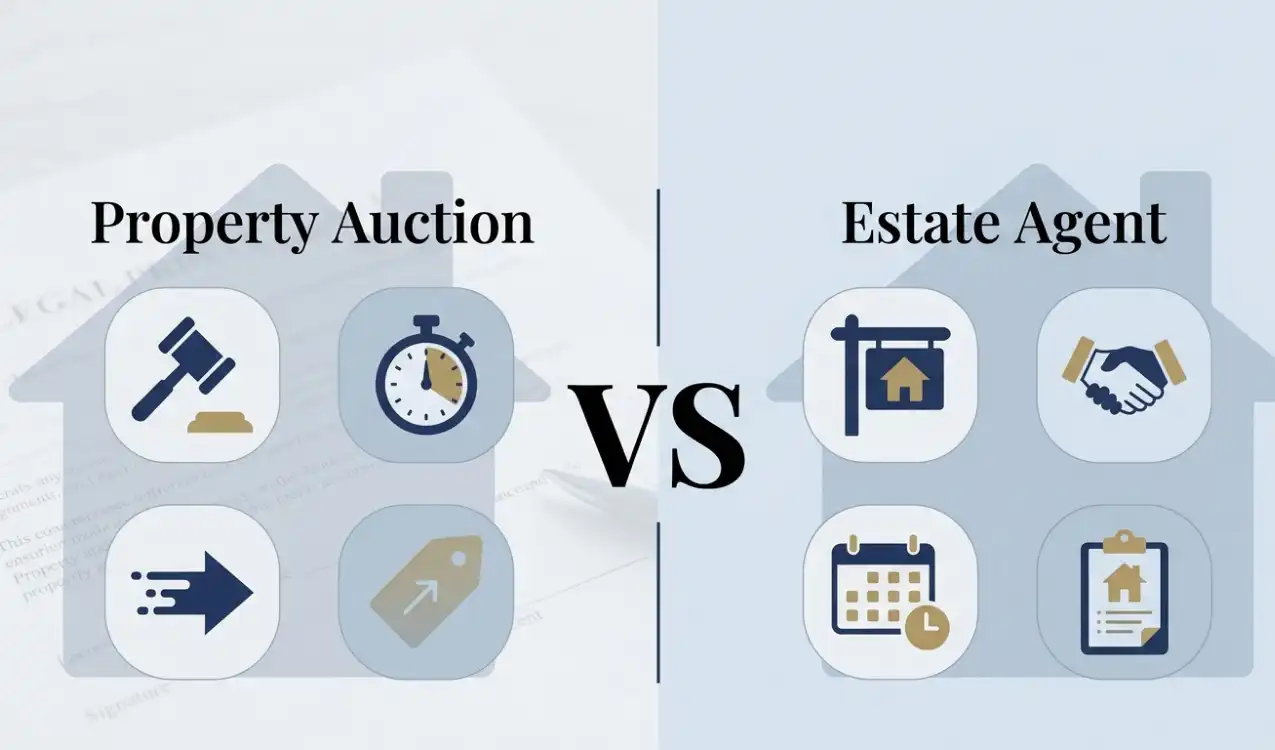
Property auction vs estate agent: which is really the better way to sell in 2026?
If you’re planning to sell a property in 2026, the property auction vs estate agent question matters more than ever. The UK housing market has shifted significantly over the past year, with fall-through rates hitting between 25 and 40 per cent through traditional routes. Choosing the wrong method can cost you months — and thousands of pounds. This guide breaks down both options so you can make the right decision for your circumstances.
How the two methods work
Before weighing up which method suits you, it helps to understand what each one actually involves.
Selling through an estate agent
The traditional route involves listing your property with a local or online agent, conducting viewings, receiving offers, and negotiating a sale price. Exchange and completion follow — but there’s no fixed deadline. Buyers can pull out at any stage right up to exchange, and many do. In 2025, roughly 4 in 10 sales agreed through this route failed to reach completion.
Selling at auction
With a property auction, your home is marketed for a set period, then sold on a specific auction date. Under a traditional (unconditional) auction, exchange happens the moment the hammer falls and completion typically follows within 28 days. The Modern Method of Auction (MMoA) offers a slightly longer 56-day completion window, which opens the process to mortgage buyers as well as cash purchasers. Either way, the buyer commits legally and financially — there is very little room for last-minute renegotiation.
If you’re a seller preparing for auction, understanding what goes into the pre-auction legal pack is one of the most important steps you can take before going to market.
Side-by-side comparison: auction vs estate agent in 2026
Here’s how the two methods compare across the factors that matter most to sellers:
| Factor | Property Auction | Estate Agent |
|---|---|---|
| Speed | Typically 4–8 weeks | Typically 14–23 weeks |
| Certainty | Very high (around 1–5% fall-through rate) | Lower certainty (around 25–40% fall-through rate) |
| Price achieved | Usually 85–90% of market value | Up to 100% of market value |
| Seller fees | Typically 2–4% + VAT (sometimes buyer-paid) | Typically 1–1.5% + VAT |
| Chain risk | Very low – usually chain-free buyers | Higher risk due to dependent chains |
When selling at auction makes more sense
Selling at auction has moved well beyond its old reputation as a last resort. The Modern Method in particular has made it a genuine mainstream choice. Here are the situations where it tends to be the stronger option.
You need a fast, secure sale
If you’re handling a probate property, breaking a chain, going through a divorce, or simply need certainty over timing, the legally binding nature of auction gives you exactly that. Once contracts exchange, the buyer cannot walk away without serious financial consequences.
The property has complications
Properties with structural issues, short leases, subsidence, non-standard construction, or Japanese knotweed can be difficult to sell on the open market. Auction attracts developers and cash buyers who have experience with exactly these situations. Rather than hiding problems and dealing with fall-throughs later, auction front-loads all the risk and pricing upfront.
You want to avoid chain collapses
Auction buyers are typically chain-free, which means you don’t have to wait on another sale completing before yours does. This alone removes one of the biggest stress points of the traditional sales process.
You have a tenanted property or investment asset
Buy-to-let properties with sitting tenants can be tricky for estate agents to sell to the typical buyer pool. Investors at auction are comfortable taking on these properties and often prefer them.

When an estate agent is still the right choice
Despite everything auctions offer, estate agents remain the better route in certain situations.
Maximising the sale price is your priority
If you’re not in a rush and your property is in excellent condition, an estate agent will typically expose it to a wider pool of buyers and allow the market to determine the highest possible price. Auction sales typically achieve 85 to 90 per cent of full market value, whereas a well-presented home in a sought-after area may achieve its full asking price — or more — through a traditional sale.
You have a high-value or unique property
Luxury homes and highly distinctive properties often need careful, targeted marketing to find the right buyer. A specialist agent can nurture that buyer relationship over weeks or months. Putting a premium property into a general auction catalogue carries the risk of it appearing distressed or undervalued.
Your home is chain-free and well-presented
If your property is in good condition, in a desirable location, and you’re not in a hurry, the open market gives you the best chance of receiving multiple competing offers — without having to accept the 10 to 15 per cent discount that auction sales sometimes involve.
Thinking about selling at auction for speed and certainty?
Auction buyers commit immediately at exchange, so your legal pack must be ready before marketing begins. Early preparation helps avoid delays, strengthens buyer confidence, and supports stronger bidding on auction day. See how our auction conveyancing supports sellers
What sellers often overlook: the legal side of auction conveyancing
One area many sellers underestimate is how legally different auction conveyancing is from a standard sale. When you sell through an estate agent, there’s time — sometimes months — to sort out legal documentation. With auction, the legal pack must be prepared and ready before the property goes to market.
This pack typically includes title documents, searches, special conditions of sale, and any relevant certificates or planning permissions. Buyers review the pack before bidding, and any problems discovered after the hammer falls are theirs to deal with — in theory. In practice, a poorly prepared legal pack can deter serious bidders or lower your final price.
Instructing a specialist early is key. The selling at auction process at AuctionSolicitor is designed specifically around these tight timelines, helping sellers get their legal pack prepared accurately and efficiently so nothing holds the sale back.
Key risks to understand before you decide
Auction: risks to consider
- If the property does not sell at auction, it can become “tainted,” making it harder to sell via an estate agent afterwards.
- You will need to pay for the legal pack upfront (typically £200–£500), regardless of whether the property sells.
- Under the Modern Method, savvy buyers may factor the reservation fee they pay into their maximum bid, which can reduce your effective net proceeds.
- The sale price may be 10 to 15 per cent below full market value.
Estate agent: risks to consider
- Fall-throughs remain common, with up to 40 per cent of agreed sales collapsing before exchange.
- Buyers can renegotiate after surveys — sometimes significantly reducing the agreed price.
- The sales process can take six months or longer, with no guarantee of completion at any stage.
Chain collapses can restart the whole process from scratch.
Property auction vs estate agent: which should you choose in 2026?
The honest answer is that neither method is universally better — it depends entirely on your property, your circumstances, and what you value most.
If speed, legal certainty, and freedom from chains are your priorities, property auction is likely the stronger choice in 2026. If maximising every pound of the sale price on a well-presented home matters more, and you can tolerate a longer, less predictable timeline, the traditional estate agent route still delivers.
What has changed is that auctions are no longer the preserve of distressed sellers or problem properties. With the rise of the Modern Method and growing acceptance among mainstream buyers, selling at auction is now a legitimate first choice for a much broader range of sellers.
Whichever route you choose, getting your legal preparation right from the outset is non-negotiable. For a full overview of what’s involved in preparing your paperwork, the auction conveyancing fees page gives a clear breakdown of what to expect — so there are no surprises further down the line.
Getting the legal side right from day one
Whether you decide on auction or estate agent, the legal preparation that underpins any property sale deserves proper specialist attention. Auction sales in particular come with strict deadlines — miss one, and the consequences can be costly.
AuctionSolicitor works exclusively within the auction market, providing fast, fixed-fee auction conveyancing for both buyers and sellers across the UK. If you’re weighing up your options or ready to move forward, getting specialist legal advice early will help you avoid the pitfalls that catch many sellers out — regardless of which sales route you choose.
For further guidance on how fall-through rates compare across different sales methods, the HomeOwners Alliance guide to selling at auction provides a helpful independent overview.
Selling at auction or considering your options?
Auction sales exchange contracts the moment the hammer falls, which means your legal pack must be prepared before the property goes to market. A properly structured auction legal pack can improve buyer confidence, reduce fall-through risk, and help protect your final sale price. Our specialist auction solicitors prepare seller legal packs early so your auction timeline stays on track from day one.
